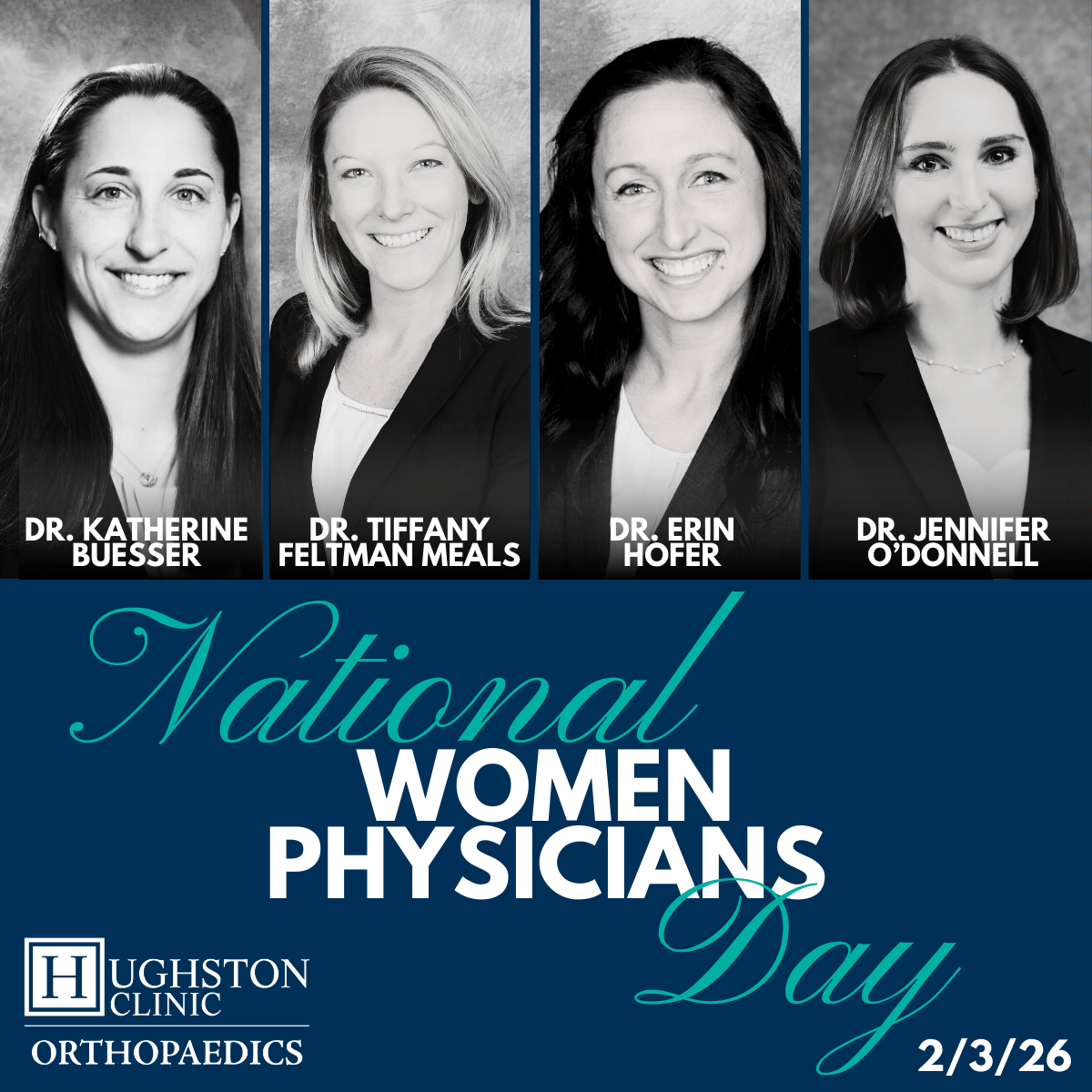
Meet the women physicians of Hughston Clinic Orthopaedics. We honor them and celebrate their dedication, knowledge, and the journeys that brought them here, forging paths for those they inspire.
We asked them a few questions about their background, inspiration, accomplishments, and more! Read on to get to know Dr. Kathrine Buesser, Dr. Tiffany Feltman Meals, Dr. Erin Hofer, and Dr. Jennifer O’Donnell!
WHY DID YOU CHOOSE THE SPECIALTY YOU DID?
Dr. Buesser: Orthopaedics was an interest of mine going into medical school. I have always been drawn to human anatomy and I though orthopaedics was the specialty that synced up the most with that interest…obviously from a surgical preparation standpoint but also understanding form and function and how that can impact a patient’s recovery after a trauma. In residency I was drawn to orthopaedic trauma as fracture care is really quintessential orthopaedics and I loved the teamwork component that is critical to hospital-based care.
Dr. Feltman Meals: When I was little, I always wanted to be a doctor to help people, and my dad is a carpenter, so I spent a lot of time growing up building dog houses for our Labrador Retriever. Putting stuff back together has been something I’ve always wanted to do, so I took that into the medical field.
Dr. Hofer: I love puzzles and fixing things. Ortho trauma challenges me and allows me to do something different every day — and it’s fun!
Dr. O’Donnell: Some of the spine problems that spine patients have are really big – sometimes weakness or they can become paralyzed if we don’t intervene. That’s why spine surgery appeals to me a lot because it can have a really large impact on their quality of life and their function.
WHAT ADVICE DO YOU HAVE FOR WOMEN PURSUING OR CONSIDERING A CAREER AS AN ORTHOPAEDIC SURGEON?
Dr. Buesser: I say go for it! Rarely are my patients surprised by seeing a female attending orthopaedic surgeon, and in fact I have a lot of patients who are excited about it. There are surely some time/monetary sacrifices to consider pursing any surgical or medical specialty , but I think that the relationship doctors have with their patients is incredibly rewarding. Professionally, there is a constant urge to improve and learn upon the surgical skills and techniques we use, and I think that keeps you engaged in a lifelong practice of medicine. Speak to and shadow as many people as you can and don’t be afraid to be the squeaky wheel!
Dr. Feltman Meals: I remember when I was in high school, I had a teacher who said I would never become an Orthopaedic Surgeon because I wasn’t strong enough or big enough. Well, proved him wrong. Maybe gave me a little more pressure to do exactly what I wanted to do. So I say, if you have a dream, go for it. Don’t let anybody stand in your way.
Dr. Hofer: If you love it, do it! Don’t be afraid to be yourself along the way.
Dr. O’Donnell: For all women pursuing their dreams, I encourage them to blaze their trail, and do not be discouraged. There will always be obstacles and bumps in the road. Be confident in your own dreams, seek out mentors and advocates in your desired field, and don’t allow others to limit you. It’s a long journey to get there but I think that if you have a passion for it, you can do it.
WHAT IS YOUR FAVORITE ASPECT OF WHAT YOU DO?
Dr. Buesser: I love the people I get to work with every day. Orthopaedic trauma is a tough specialty to be a part of, whether that is in the OR on injury day zero or months later in the clinic trying to get our patients back to the lives they want to live. It starts with the incredible partners I have in Dr. Evans and Dr. Hofer. As the new surgeon on the block, I am incredibly thankful to be part of a group that is committed to a high level of orthopaedic care. I have the privilege of learning from them on a daily basis, and I know my development as a surgeon is in no small part to their support. Additionally, I work with incredibly dedicated and enthusiastic OR teams that put up with my music (tends to not have any words) and who put 100% effort into taking care of the patients that come into the hospital. Last but not least is the clinic and physician assistant staff that keeps tabs on the hundreds of patients we care for during the year as we navigate their trauma and recovery from the hospital or their last clinic follow-up!
Dr. Feltman Meals: Seeing patients be able to go back to their normal lifestyles, playing with their grandkids, going for walks, going to the beach, and living their lives, and getting back to their normal daily activities—that is the most gratifying thing to me. I truly believe hip and knee replacement changes your life.
Dr. Hofer: Planning a surgery, executing that plan, then seeing a patient benefit from that work is very gratifying.
Dr. O’Donnell: My favorite aspect of this job is seeing patients getting better, even if that’s simply from a medication I prescribed, up to those who I am seeing after surgery who are feeling better. That is what keeps us doing this!
WHAT IS AN ACCOMPLISHMENT YOU’RE PROUD OF, PERSONALLY OR PROFESSIONALLY?
Dr. Buesser: I have been really excited to see what professional women’s hockey has become in 2025. I am proud to have been one of the players in the infancy of the movement, on a team that no longer exists (The Boston Blades) in a league that no longer exists (The Canadian Women’s Hockey League)! I certainly was not an original trailblazer in women’s hockey…that credit goes to the women who were part of the first collegiate club teams in the 60s and 70s that laid the framework for the strong NCAA women’s field that we have today. I am proud to have been an intermediary step to what now exists, the 8- team PWHL showcasing the best there is of post-collegiate women’s hockey. Looking forward to cheering on the US team in the Olympics coming up next month…another opportunity to showcase the sport and continue the success that prior teams have achieved!
Dr. Feltman Meals: I am the first female partner at Hughston Clinic Orthopaedics.
Dr. Hofer: I’m proud that people want to be on my team in the OR (or so they say ;)). We have some amazing surgical techs, first assistants, and nurses at Skyline and I’m honored that they want to work with me.
Dr. O’Donnell: I’m proud of developing resilience — learning how to manage demanding responsibilities while continuing to grow, reflect, and improve rather than burning out or cutting corners. This is something I’ve developed over the years of training and schooling that have brought me to this point, as well as my life outside of work!
WHAT ARE YOUR GOALS FOR PATIENT CARE? WHAT DO YOU HOPE PATIENTS FEEL AFTER AN APPOINTMENT WITH YOU?
Dr. Buesser: My goal is for them to truly understand their injury, why I did what I did in surgery, and to encourage their post-surgical participation in the recovery process. I make sure that I go over pre-and post-operative radiographs, so my patients have a visual understanding of what was done, hopefully giving context to the restrictions I may have on them. I often run behind in clinic, but it is because I want every question, big or small, answered for the patient and their families before leaving. I hope that patients have felt like they had an honest interaction with me, whether it be in a case with complications or one that was complication-free.
Dr. Feltman Meals: It is teamwork between myself, the patient, and my staff in getting the patient the best outcome. I want them to know that we are here to support them.
Dr. Hofer: My main goal is to help my patients get back to their pre-injury function and normal lives. Along the way, I hope they feel understood, cared for, and well-taken care of.
Dr. O’Donnell: After a visit with me, what I’m hoping is that the patient feels that we’ve worked together as a team between me and my support staff and the patient and their family and loved ones, that we’ve come together and come up with a treatment plan that everyone’s happy about whether that entails surgery or not.
Last edited on February 3, 2026