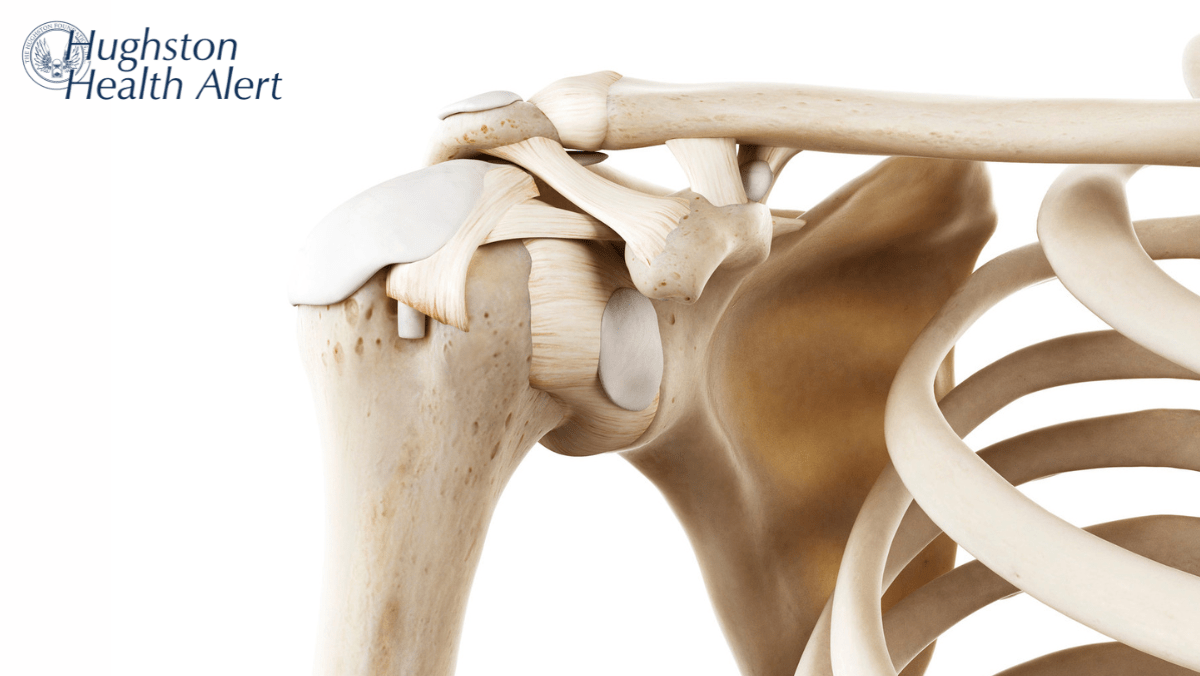
The American Academy of Orthopaedic Surgeons reports that approximately 4.5 million patient visits occur each year because of shoulder pain. Ultimately, many of these patients are diagnosed with a torn rotator cuff. A rotator cuff injury is a strain (stretching or tearing a muscle or tendon) in the muscle group that holds your shoulder joint together. Rotator cuff injuries affect both athletic and nonathletic populations, causing shoulder pain, weakness, and decreased range of motion. Common and treatable, rotator cuff tears can result from a traumatic injury to your shoulder, with increasing age, or from activity-related degenerative changes.
Anatomy
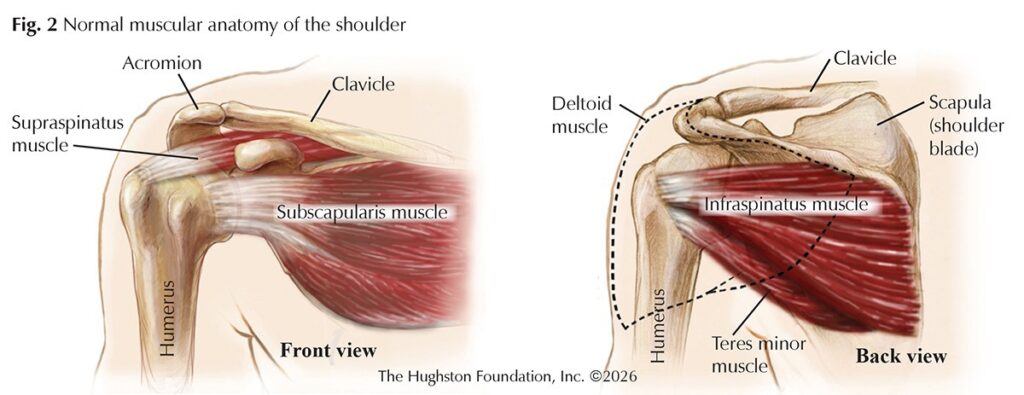
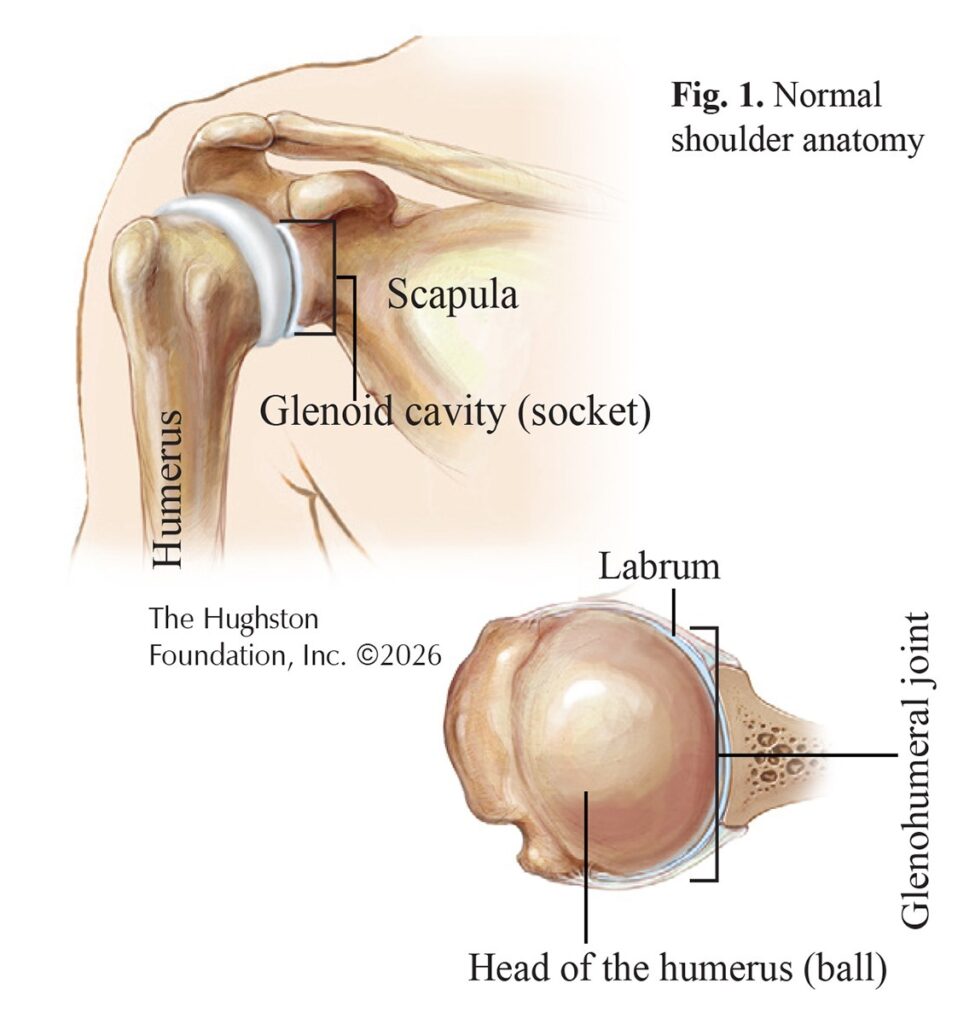 The rotator cuff holds the humeral head in place and helps to stabilize the shoulder (glenohumeral) joint (Fig. 1). The rotator cuff is a collection of 4 tendons that attach muscles to the head of the humerus (upper arm bone). The supraspinatus, infraspinatus, teres minor, and subscapularis muscles facilitate a wide range of motion, especially during certain activities like throwing, lifting, swimming, or reaching. The supraspinatus aids with abduction (lifting the arm out to the side), while the infraspinatus and teres minor muscles assist with external rotation, or rotating the arm outward. The subscapularis helps with internal rotation, or rotating the arm inward. (Fig. 2)
Risk factors
Rotator cuff tears can occur acutely (suddenly) or chronically (long-term) from multiple causes. Acute injuries happen after a traumatic event, such as a fall, lifting something heavy, a sporting accident, or a shoulder dislocation. Chronic tears typically develop over a prolonged period in the older population from intrinsic degeneration (deterioration of tissue) or chronic impingement (persistent compression). Many factors can contribute to rotator cuff tears. A specific factor to consider is repetitive overhead motion, which can make throwing athletes, swimmers, painters, and carpenters more vulnerable to rotator cuff tears. Other risk factors include increasing age, smoking, a family history of rotator cuff tears, or other medical conditions, like hypercholesterolemia (high cholesterol).
Diagnosis
Diagnosing rotator cuff injuries is characteristically a clinical finding. During a clinic visit, the orthopaedist completes a careful medical history and asks about symptoms and exacerbating factors. The doctor also performs a thorough physical exam using specialized tests that help pinpoint the torn rotator cuff tendon. Imaging tools, such as radiographs (x-ray), arthrogram (x-ray that uses contrast), magnetic resonance imaging, or MRI (shows bones, muscles, tendons, and ligaments), or ultrasound (uses soundwaves to view inside the shoulder), can assist in making or confirming a diagnosis. Most orthopaedists consider MRI the diagnostic standard for rotator cuff injuries because it provides detailed images of the surrounding muscles and helps to evaluate bone quality.
Treatment options
There are both nonsurgical and surgical treatment options for rotator cuff tears, depending on your age and overall health, activity level, mechanism, size, and chronicity (duration) of the tear, and degree of muscle atrophy (shrinkage). First-line nonsurgical options include rest, activity modification, physical therapy, nonsteroidal anti-inflammatory medications (NSAIDs), and corticosteroid injections. Physical therapy focuses on rotator cuff strengthening and scapular-stabilizing exercises. Physicians often treat patients who have partial rotator cuff tears or have low-activity lifestyles with these nonsurgical treatments.
Surgeons can perform rotator cuff surgery using a minimally invasive approach through small incisions, called arthroscopic surgery (a tiny camera and instruments are inserted into the joint) or through an open, larger incision. Your surgeon will choose the best approach based on your injury. This might involve cleaning out the joint space (decompression or debridement) or rotator cuff repair to reattach the torn tendons. In severe cases with massive or irreparable tears, it may be more practical to perform a tendon transfer or shoulder replacement surgery. Postoperatively, you need consistent physical therapy to restore motion and strength. You can expect to return to play or work without restrictions approximately 6 months after surgery; however, the exact timeline is patient-dependent.
Rotator cuff surgery does not come without risks. One of the most common complications after surgery is rotator cuff tear recurrence, which happens when the cuff tissue fails to heal. Surgery failure or a recurrent tear is more likely to occur in patients who have diabetes, are over age 65, smoke, had a large tear, and did not follow postoperative recommendations. Other notable complications include neurovascular injury, infection (with an incidence of <1%), and joint stiffness.
Prevention
Preventative strategies can help you avoid rotator cuff injury. For active individuals, warming up prior to sporting activities and performing all maneuvers using the correct technique and mechanics can help strengthen your shoulder. With exercise that focuses on stretching and strengthening the rotator cuff and stabilizing the muscles that attach to the scapula, you can keep the shoulder muscles strong and flexible.
The rotator cuff tendons can become inflamed, partially torn, or completely torn. How your doctor treats it depends on the size of the tear and how much it hurts. If your tear is minor and it does not affect or change your lifestyle, you and your physician may decide to let it heal without much intervention. On the other hand, if you have a large, painful tear that affects your daily living, your orthopaedist may recommend surgery. By properly diagnosing and treating your injury, you can regain strength, function, and return to your desired activities. With enhancements in research, conservative treatment modalities, and surgical techniques, a pain-free shoulder is possible.
Author: Cole Connelley, DO | Columbus, Georgia
Last edited on August 2, 2026